

Watco Fundamentals · Part 4
The Condenser Fouling Process: Why It’s Already Underway Before You Notice It
Fouling does not start when you notice it. It started long before that. By the time it shows up in your data, the process is already well underway.
Not an event — a process
Fouling is not a problem that suddenly appears. It is a process that begins from the first day condenser water flows through a system and develops continuously from there.
The common mental model — system runs fine, fouling is found, tubes are cleaned, back to normal — treats fouling as an event. That model is wrong, and the gap between the model and reality is where energy cost quietly disappears.
Understanding fouling as a process changes how you manage it.
How the condenser fouling process actually develops
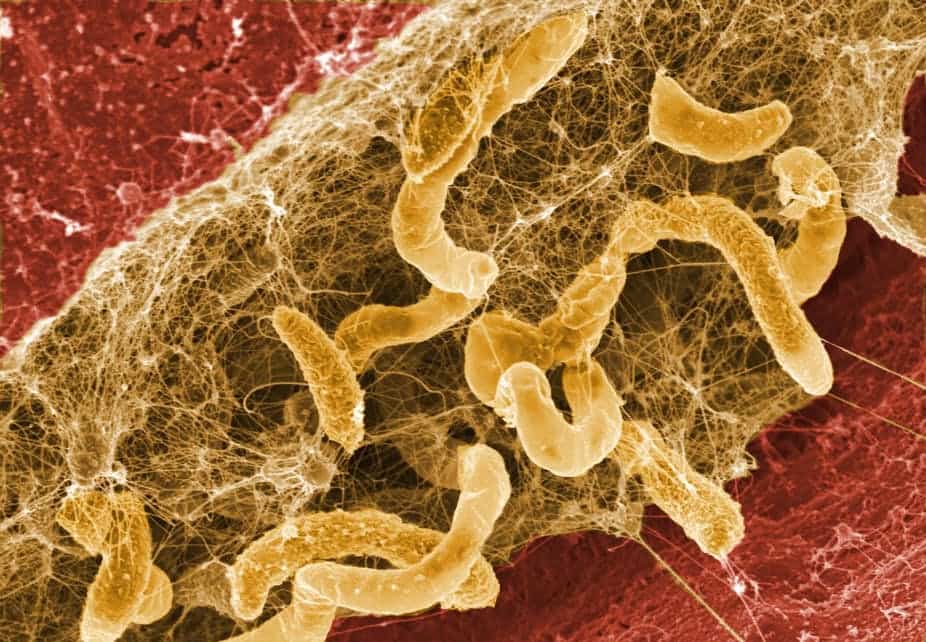
Condenser tubes operate in an environment that almost guarantees deposit formation. Warm condenser water, carrying dissolved minerals, biological material, and suspended particles, flows continuously across metal surfaces. The conditions for fouling — temperature gradients, surface roughness, water chemistry — are always present.
In the early stage, deposits are thin and nearly invisible. A light film of biofilm, a faint calcium carbonate layer. The system runs normally. No alarm sounds. Nothing in the operational data suggests a problem. This stage can last weeks or months — and because nothing appears to be wrong, nothing gets done.
What makes this phase particularly costly is not the fouling itself, but the lost opportunity. Every day that passes without intervention is a day the deposit thickens, hardens, and becomes more resistant to removal.
The S-curve: why fouling accelerates before it slows
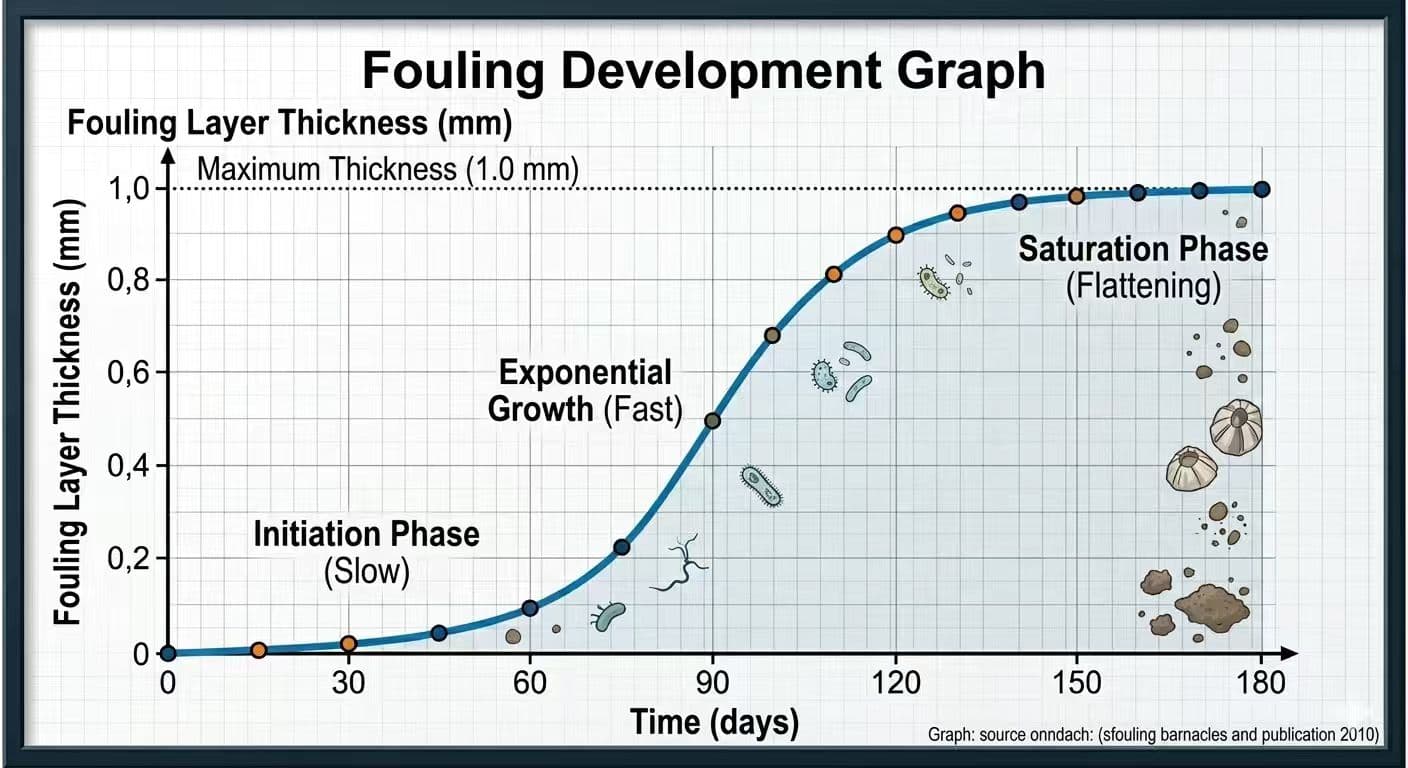
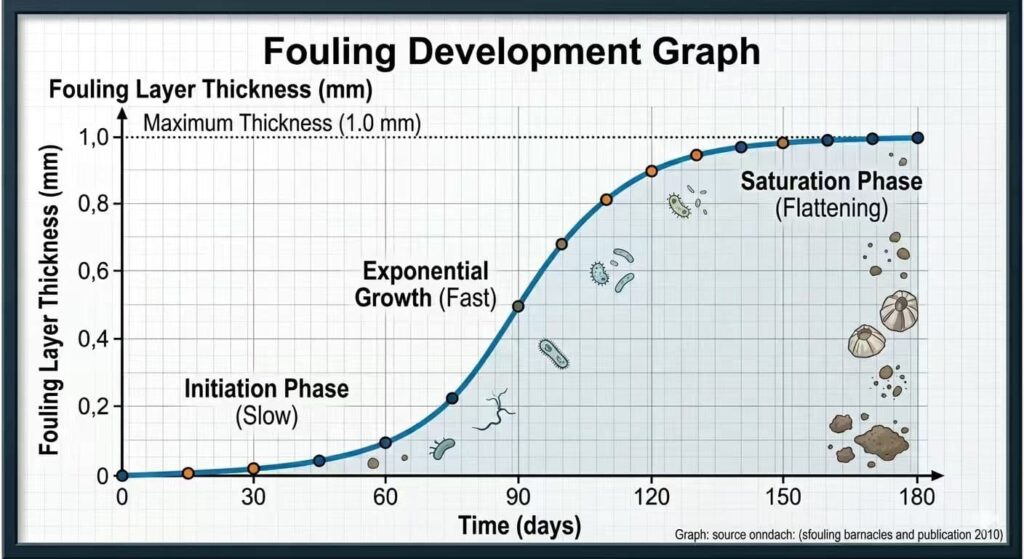
Fouling growth is not linear. It follows a pattern that engineers describe as an S-curve — and understanding that shape explains why early intervention matters far more than late intervention.
In the initial phase, deposits form slowly on relatively smooth tube surfaces. The thermal and hydraulic impact on system performance is minimal.
As deposits build, the tube surface becomes rougher. Rougher surfaces trap further deposits more readily — biofilm clings more easily, scale nucleates more quickly. The fouling rate accelerates. This is the steep section of the S-curve, where each passing day adds meaningfully to the insulating layer and the performance penalty compounds.
Eventually, higher flow velocities begin to erode the outer layers of the deposit and the rate of new accumulation slows toward a plateau.
The period when fouling is hardest to detect — the early, slow-building phase — is also the period when it is easiest and cheapest to address.
For a technical overview of fouling mechanisms and heat rejection methods, see Heat Rejection Options in HVAC Systems (CEDengineering.com, Course M04-029).

Reading the signal — carefully
Eventually, something does show up in the operational data. Without any change in load or ambient conditions, the condenser approach temperature begins to rise — and the condensing pressure creeps upward with it.
The approach temperature is a useful starting point for diagnosis, but it needs to be read carefully and always in combination with running conditions and absolute condenser temperatures and pressures.
A drop in load will on its own improve the approach temperature. A partially blocked strainer, or reduced condenser water flow for any other reason, will also compress the approach temperature — while at the same time pushing absolute condensing pressure and temperature upward. Fouling in the tubes does the same: the approach temperature may look acceptable in isolation while the absolute condenser pressure tells a different story.
The most useful diagnostic signal is the combination of approach temperature, absolute condensing conditions, and condenser water flow, all evaluated relative to what the system should be achieving under its current load and ambient conditions. A rising approach temperature under stable load and stable flow, accompanied by rising condensing pressure, is a reliable fouling signal.
By the time any of these signals becomes clearly abnormal, the fouling process has typically been running for weeks or months.
What a 3°C shift actually means
When the approach temperature rises from 2°C to 5°C under genuinely stable operating conditions — same load, same condenser water flow, same ambient wet-bulb — that 3°C shift reflects real insulation on the heat transfer surface.
It corresponds to a higher condensing pressure, which requires the compressor to do more work to achieve the same refrigerant condensation. The efficiency penalty is measurable — typically in the range of 2–3% additional energy consumption per degree Celsius of elevated approach temperature under those stable conditions.
On a large chiller running continuously, that is not a small number. And because the signal only becomes legible after weeks of gradual drift, the accumulated cost by the time it is acted upon is always larger than it needed to be.
Why the event model leads to the wrong decisions
If fouling is treated as an event, the management response is reactive: wait until fouling is detectable, then clean. This approach has a logic — cleaning costs money and takes equipment offline, so the instinct is to defer until necessary.
But the event model underestimates what happens during the waiting period. Every week between the point where fouling becomes performance-relevant and the point where it is finally addressed is a week of elevated energy consumption, increased compressor wear, and reduced margin against peak demand — the design conditions discussed in Part 3 of this series.
If fouling is treated as a process, the question shifts from when should we clean? to how do we keep the system from drifting in the first place? And when drift is already occurring: how early can we detect it, and in which subsystem is it actually occurring?
The condenser fouling process and system margin
A fouled condenser raises the condensing pressure and increases compressor lift — eroding exactly the operating margin discussed in Part 3. Fouling does not cause the system to fail at average conditions. It causes it to fail at design conditions, when the margin quietly consumed over months of undetected deposit growth is no longer there.
This is why the condenser fouling process matters beyond energy costs. It is a direct threat to system reliability at the moments that matter most.
Two responses to the same problem
Knowing that fouling is a continuous process rather than a sudden event points toward two practical responses — one preventive, one diagnostic.
The preventive response is to stop fouling from accumulating in the first place. Keeping condenser tubes continuously clean eliminates the performance drift before it begins, rather than managing its consequences after the fact.
The diagnostic response is to monitor condenser performance in a way that can indicate whether fouling is likely occurring — by tracking condenser thermal performance relative to actual running conditions, rather than reading approach temperature in isolation.
Neither response replaces the other. Prevention keeps the system clean. Monitoring tells you whether it is staying that way.
Two responses to the same problem.
Keep condenser tubes continuously clean with EQOBRUSH. Monitor whether fouling is likely occurring with EQOCHECK.
This article is part of the Watco Fundamentals series.
What is Cooling? | F01
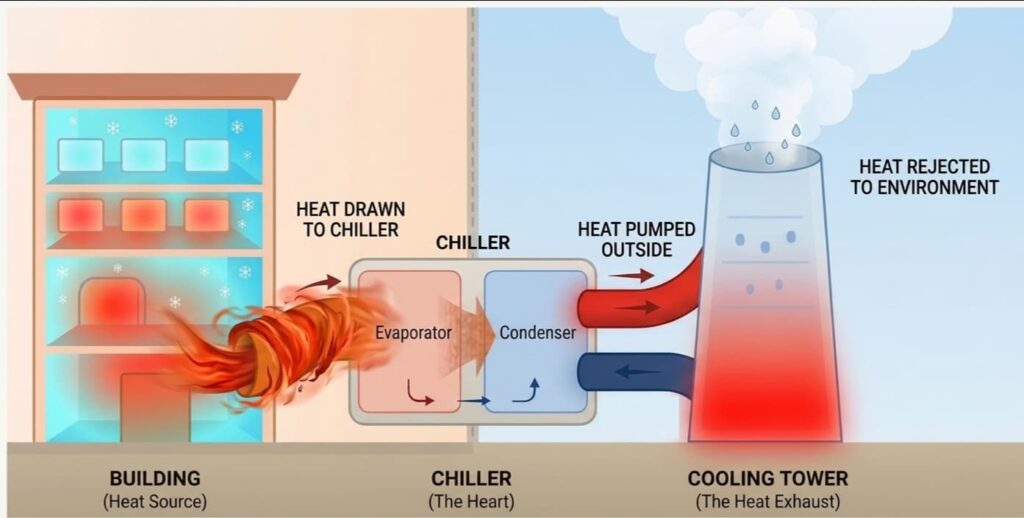
Heat Removal in Cooling Systems | F02
What are Heat Rejection Design Conditions | F03
Condenser Fouling Process | F04