

BACK FLUSHING HEAT EXCHANGERS: AN EFFECTIVE METHOD TO AVOID THE ACCUMULATION OF FOULING
Back flushing heat exchangers is a systematic process to minimize fouling. Patented flow reversal valves offer an intelligent solution, ensuring minimal pressure loss and installation impact. Standard 2, 3, or 4-way valves present a cost-effective alternative for those prioritizing initial investment over long-term operational expenses. Explore these strategies further below.
Fouling build-up in heat exchangers connected to cooling towers is a major issue that impacts performance of the heat exchanger and (chiller) condensers. A regular and automatic backflush of the installation is a smart strategy that helps getting rid of the deposited matter before it settles and crystallizes and that maintains optimal performance through maximum heat exchange efficiency. The backflow just needs to last for a short period, approximately 15-30 seconds, and doesn’t noticeably affect the heat exchange process. The flow to the cooling tower, naturally, cannot be reversed.
Table of Contents
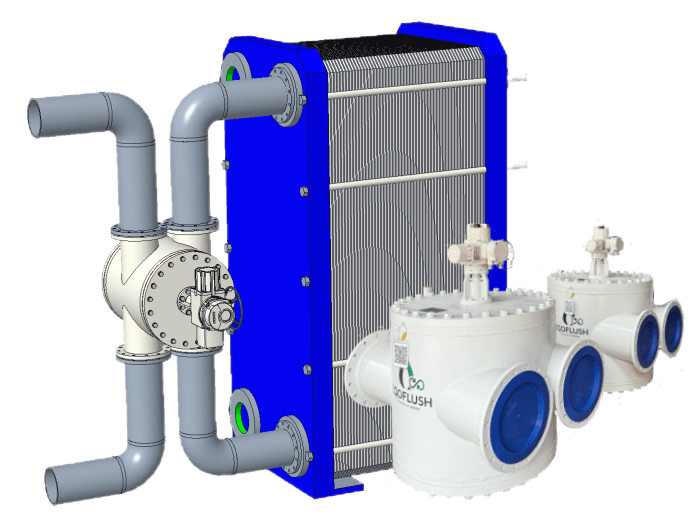
Since the back flushing heat exchangers is executed during operation, the cost of manpower, cleaning equipment, and standstill or production losses are minimized. Also, it extends the interval between cleaning sessions.
In plate heat exchangers, back-flushing washes away debris stuck at the cooling water inlet of the unit. For shell and tube heat exchangers, the back-flush works best in combination with brushes that travel through the tubes in response to the reversed flow. They nestle in catch baskets, designed for minimal flow restrictions, at the end of each tube during normal operation.
Here we present various methods for accomplishing back flushing heat exchangers: reversing the flow over the heat exchanger without altering the flow direction to the cooling tower. Each approach offers distinct advantages and disadvantages in terms of practical implementation, technical complexity, and associated costs.
Engineering Solutions to Automate Backflushing:
BUTTERFLY VALVES (x4)
Synchronizing 4 butterfly valves is crucial for reversing flow during the back flushing heat exchangers, preventing water from stagnating for too long. However, this setup presents control challenges, as a single defective actuator can cause system failure. Moreover, it increases the footprint and requires higher capital expenditure due to the need for four actuators of equal power.

3-WAY VALVES (x2)
Synchronizing a set of 3-Way valves is essential for the back flushing heat exchangers process to reverse flow without water stagnating for extended periods. However, this setup poses control challenges, as a single defective actuator can lead to system failure. Additionally, it results in a footprint increase and requires higher capital expenditure due to the necessity of two actuators of equal power.

4-WAY VALVE (x1)
The 4-way valve presents challenges in fitting into piping solutions due to its shape, leading to increased footprint and installation complexities. Moreover, it poses operational expenditure (OPEX) issues, including constant pressure loss due to piping elbows. While it offers limited capital expenditure (CAPEX) advantages compared to Flow Reversal Valves, its drawbacks may outweigh the cost benefits.
Our preference for 4-way valves is primarily for back flushing heat exchangers with small pipe diameters, where the CAPEX advantage is most pronounced. In such scenarios, the cost benefit of 4-way valves outweighs their installation complexities and operational considerations.

INTEGRATED FLOW REVERSAL VALVE (x1)
The most advanced method for effective flow reversal is the Integrated 4-Way Valve. While traditional systems often rely on complex piping and multiple actuators, the Flow Reversal Valve combines everything into a single, compact unit. This is the ultimate “set-and-forget” solution for modern installations.
By reversing the flow internally, the provides maximum reliability with a minimal footprint. The result is a superior cleaning process without the technical headaches of complicated manifold constructions. For those striving for peak efficiency and the lowest operational costs, this is the logical choice.

Want to understand how the quality of the flow reversal process impacts cleaning performance?
- Transition time and its effect on flow distribution
- Crossover and loss of effective flow
- Backflush burst quality and cleaning force
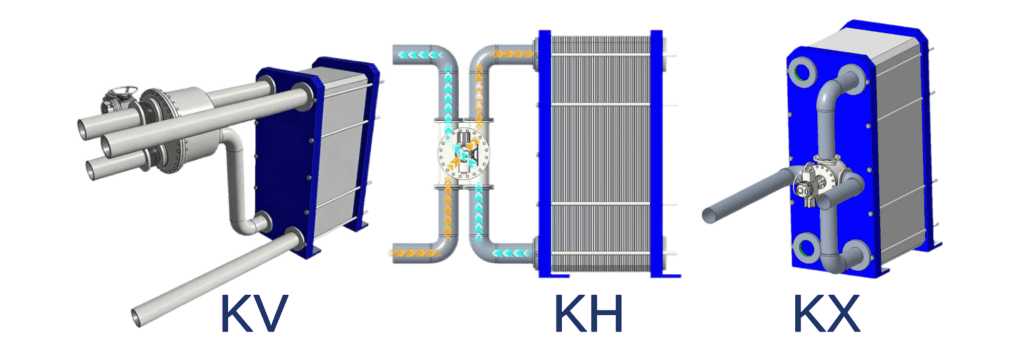
Flow Reversal Valves
Our preferred solution for back flushing heat exchangers are our integrated Flow Reversal Valves.
While it requires a slightly higher initial investment (CAPEX), it offers years of trouble-free operation with minimal pressure loss and cold water crossover into the warm water stream.
This Flow Reversal Valve is engineered for minimal pressure loss, occurring solely during the system’s cleaning cycle, totaling approximately 5 minutes per 24 hours of operation.

STOP THE PLUMBING NIGHTMARE
The Reality of Traditional Back-Flushing
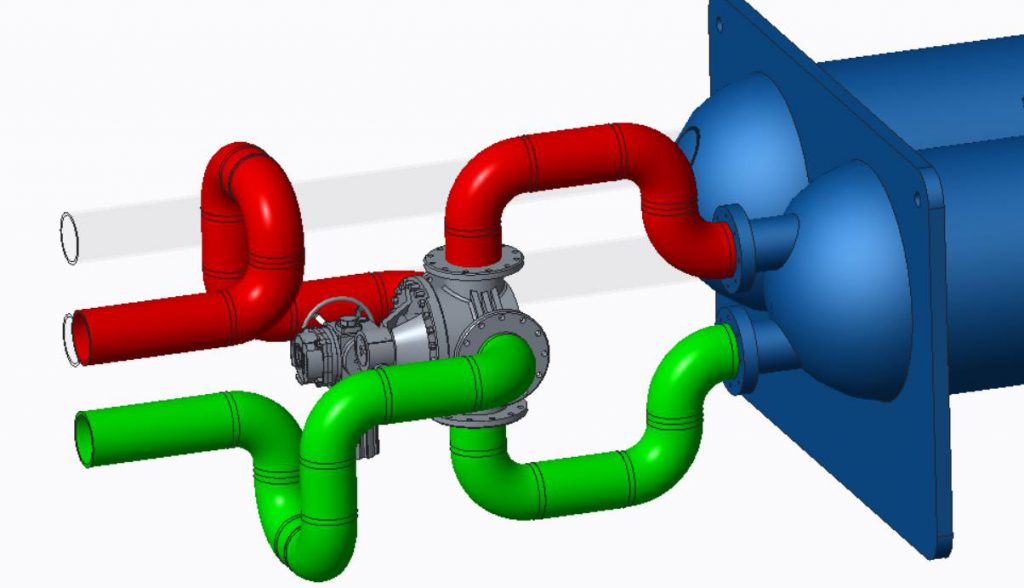
The image on the right illustrates why traditional back-flushing is often a design and maintenance headache. Building a flow-reversal setup using standard piping and multiple valves creates a “plumbing jungle” that is far from efficient.
The hidden costs of this complexity:
Excessive Pressure Drop: Every extra 90-degree bend and T-junction increases resistance, forcing your pumps to work harder and wasting energy.
High Installation Risk: With dozens of connection points and multiple actuators, you are significantly increasing the potential for leaks and mechanical failure.
Wasted Footprint: These bulky manifolds require massive amounts of space, complicating plant layout and accessibility.
Design Overhead: Engineering, sourcing, and assembling these custom structures costs time and money that could be spent elsewhere.
There is a better way.
The Integrated 4-Way Valve (FWV) replaces this entire network of pipes with a single, streamlined component. It eliminates the “pipe nightmare” by handling the flow reversal internally, giving you a cleaner, more reliable, and energy-efficient installation.
Back Flushing Heat Exchangers approach: You get what you pay for…
WHAT TO CONSIDER IN DECISION MAKING
- Process Management
- Size Limitations
- Technical Realization
- Cross Over
- Pressure Loss
- CAPEX
CONCLUSION:
In critical processes where significant gains are at stake, opting for inexpensive solutions may lead to short-term benefits but long-term drawbacks. We advocate for thoughtful consideration of the optimal solution, prioritizing return on investment (ROI) and ensuring worry-free operations over an extended period.
Reading tip on backflushing of heat exchangers:
HPAC-magazine (Heat Plumbing and Air Conditioning): Changing Flow Direction for Optimal Heat Exchanger Performance
Chemical Processing: Backflush Away Fouling
Flow Reversal Quality Matters More Than You Think.
- Real-world comparison of valve strategies
- Why slow reversal creates uneven cleaning
- Impact on plate and tube heat exchangers