


Technical Resource
Why Pressure Drop Is Often the Wrong Metric
Chiller Tube Cleaning Pressure Drop: The Engineering Facts
A common objection — often raised by chiller OEM representatives — is that automatic brush cleaning systems increase pressure loss and risk chiller surging. We give you the engineering reality.

<0.05 bar
Pressure drop added by EQOBRUSH
0.5–1%
COP reduction from system components
10%+
COP loss from just 0.3 mm fouling
The concern
Two objections. Both answerable.
When a prospective client brings up chiller tube cleaning pressure drop and surging risk after speaking with a chiller sales representative, it usually reflects a comparison of the wrong baselines. Here is what the engineering data actually shows.
Chiller Efficiency Starts at the Condenser Temperature — Not the Pressure Drop
Pressure drop can reduce water flow, which may slightly increase condenser temperature (when compared to the baseline of a 100% fouling free chiller without a tube cleaning device). However, the primary objective should always remain clear: maintaining the lowest possible condenser temperature and pressure to protect chiller efficiency.
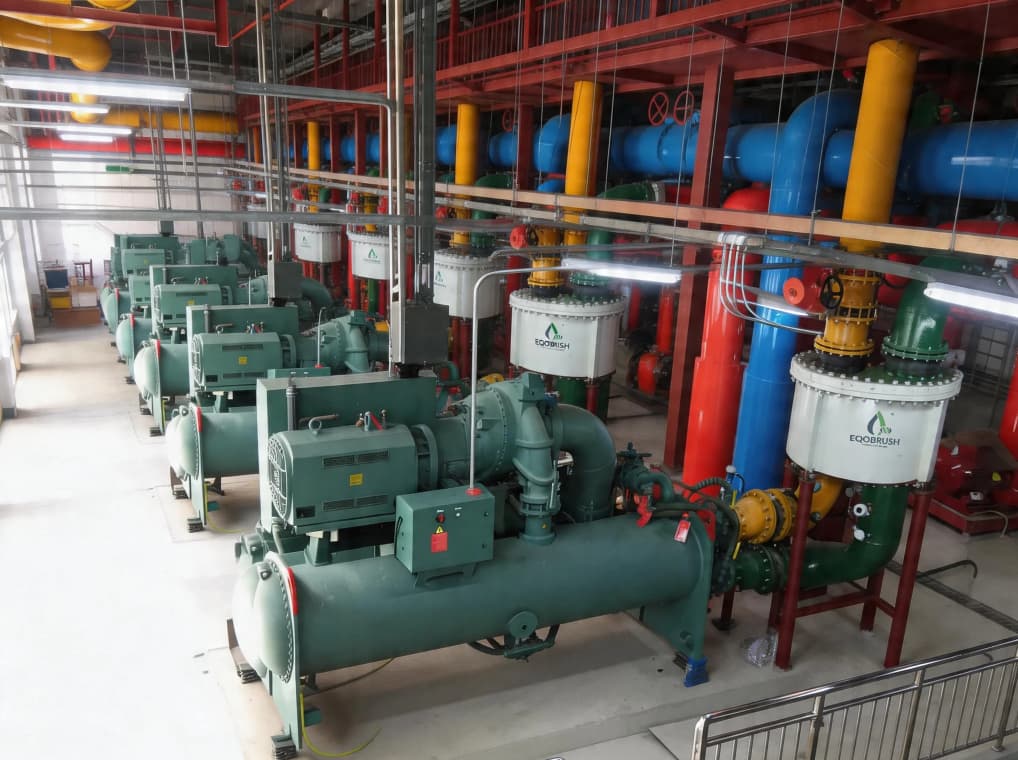
Nevertheless, the EQOBRUSH flow reversal valves are specifically engineered to minimize additional pressure drop. Computational fluid dynamics (CFD) analysis and practical field experience show that the complete system typically adds only 0.03 to 0.05 bar to a condenser circuit that normally operates around 0.3 bar differential pressure.
In practical terms, this small increase in pressure drop may result in an estimated 0.5% to 1% reduction in chiller COP due to slightly reduced flow.
By comparison, even a relatively thin fouling layer of approximately 0.3 mm on condenser tubes reduces chiller COP by up to 10% due to elevated condensing temperatures and compressor lift.
The comparison is therefore straightforward:
- Minor pressure drop increase: approximately 0.5–1% potential COP impact
- Light condenser fouling: up to 10% COP reduction
Additionally, the brushes themselves do not create continuous pressure loss during normal operation. During standard chiller operation, the brushes remain parked inside their catch baskets and are outside the active tube flow path.
Chiller surging occurs when the pressure difference between the evaporator and the condenser exceeds compressor’s stable operating threshold — leading to pressure fluctuations, noise, vibration, and potential mechanical damage to the impeller, bearings, and seals. The primary cause of surge is not tube cleaning. It is fouling.
Fouling forces the compressor to operate at elevated temperatures and pressures — pushing it progressively closer to its aerodynamic surge limit. EQOBRUSH prevents this by keeping condenser tubes continuously clean. For sensitive chillers that may be at risk during the brief period of flow reversal in the conderser, the system offers BMS-integrated surge avoidance logic.
In many chiller plants, multiple chillers operate on the same condenser water loop while receiving unequal condenser water flow rates.
As a result, chillers operating under identical load and cooling tower conditions can show significantly different condensing temperatures and compressor power consumption.
This is not a chiller problem — it is a hydraulic balancing problem.
From an efficiency perspective, the primary objective should always be:
- the lowest stable condensing temperature,
- equal condenser water distribution,
- and optimal heat rejection performance across the plant.
Pressure drop is not the problem. Unequal pressure drop under identical operating conditions is.
When chillers connected to the same condenser water system operate with different pressure drops, flow rates, or condensing temperatures under otherwise identical conditions, this indicates hydraulic imbalance within the plant.
In practice, this means the chillers are not operating at the same efficiency level. One or more machines will inevitably operate at higher condensing temperatures and compressor lift than others, resulting in unnecessary energy consumption and reduced overall plant efficiency.
The numbers
EQOBRUSH vs. Fouling: a direct comparison
Chiller without automated cleaning
Chiller with EQOBRUSH
| Scale thickness | Fouling factor | Power increase required |
|---|---|---|
| 0.03 mm | 0.0001 | 1.1% |
| 0.15 mm | 0.0005 | 5.5% |
| 0.30 mm | 0.0010 | 11.0% |
| 0.61 mm | 0.0020 | 22.0% |
| 0.91 mm | 0.0030 | 33.0% |
| 1.22 mm | 0.0040 | 44.0% |
Source: EQOBRUSH Energy Performance Contract documentation, Watco Group.
Surge avoidance
Intelligent control for sensitive installations
EQOBRUSH as master
Before each cleaning cycle, the control box sends a signal to the chiller — commanding a load reduction. The cleaning cycle begins approximately one minute later. Once complete, the chiller automatically resumes normal duty. The safe load threshold is determined through a commissioning procedure.
EQOBRUSH as slave
The system waits for a signal from the chiller indicating its load is already below a safe threshold. Upon receiving the signal, EQOBRUSH runs three cleaning cycles within a three-minute window. Particularly effective during startup, partial-load periods, or overnight operation.
Broader benefits
Beyond pressure drop: The tangible benefits of EQOBRUSH Automatic Brush Cleaning
Read the full technical analysis: Pressure Drop, Flow Loss and Surging Concerns18-page engineering report with ANSYS flow data, fouling factor tables, and COP calculations.
Frequently asked questions
Common questions about EQOBRUSH and chiller performance
Questions we hear from facility managers, HVAC engineers, and energy consultants — answered with data.
No. The total additional pressure drop introduced by EQOBRUSH — including the flow reversal valve, catch baskets, and brushes — is 0.03 to 0.05 bar. A typical chiller condenser circuit operates at around 0.3 bar, so this represents roughly a 10% hydraulic addition. Translated to chiller efficiency, the COP impact is estimated at 0.5% to 1% — negligible in any operational context. The brushes themselves, when resting in their catch baskets between cleaning cycles, add zero pressure loss to the tube flow path.
The comparison is stark. A fouling layer of just 0.3 mm reduces a 20 mm tube’s internal diameter to approximately 19.4 mm — enough to increase pressure drop to 0.07–0.10 bar and reduce chiller COP by up to 10%. At 1 mm of scale, energy consumption increases by up to 30–44%. EQOBRUSH prevents this accumulation continuously, meaning the chiller always operates at or near its clean-tube design efficiency.
For most installations, no. The cleaning cycle lasts approximately 30 seconds and occurs every 4 to 6 hours. More importantly, tube fouling is itself the primary driver of chiller surge. EQOBRUSH actively reduces that risk by keeping heat transfer surfaces clean. For sensitive chillers, BMS-integrated surge avoidance modes are available: master mode (EQOBRUSH commands load reduction before cleaning) and slave mode (EQOBRUSH waits for a low-load signal from the chiller).
EQOBRUSH physically removes deposits before they harden, addressing all four primary fouling mechanisms simultaneously: scaling (mineral precipitation from cooling tower water), particulate fouling (silt, rust, and suspended solids), biofouling (algae, bacteria, and microbial slime), and corrosion fouling (copper oxide and oxidation products). Because these mechanisms are interconnected, preventing one type has a cascading positive effect on the others.
Cleaning cycles are typically set to run every 4 hours for approximately 30 seconds — configurable based on water quality and contamination levels. The chiller continues operating normally throughout. There is no shutdown, no manual intervention, and no chemical handling required. Debris is flushed into the cooling tower basin and eliminated via standard blowdown.
Energy savings typically range from 10% to 40% depending on pre-installation fouling conditions. Payback periods are often under 12 months, and full system ownership through an EPC structure can be achieved within two years without upfront capital investment. Additional savings come from eliminated manual cleaning, reduced water treatment chemical use, and an estimated 20% extension of equipment lifespan.