


Thermal Balancing Basin as an Effective Solution for Handling High Cooling Tower Water Temperature Ranges
How to achieve a larger temperature range with minimal increase in cooling tower footprint.
High cooling ranges are often assumed to require oversized cooling towers.
In practice, similar results can be achieved by introducing a thermal balancing basin.
This article explains the concept and its practical implications.
Definitions:
RANGE
is the temperature difference between the hot water entering the cooling tower and the cold water exiting the cooling tower.
APPROACH
is the difference between the cold cooling tower water and the Wet Bulb Temperature.
HIGH RANGE
High cooling tower water temperature range – is a range of more than 12C in the cooling tower system.
CASCADING
The use of multiple cooling towers placed in series
Cooling towers normally handle a range of up to 12C, which poses a challenge for applications where a wider cooling tower water temperature range is required. Wacon’s thermal balancing basin concept has a proven track record in Europe and Asia and optimizes the operation for both footprint and Capex.
Challenges addressed through Thermal Balancing Basin:
Cascading is Sub-Optimal for High Range Cooling Tower Projects
ENLARGED FOOTPRINT
A cascade cooling tower configuration requires two separate units, resulting in a significantly larger footprint. In space-constrained environments, this can be a limiting factor. By contrast, a thermal balancing basin can often be integrated beneath or adjacent to a single cooling tower, allowing the same thermal performance to be achieved with a much more compact overall layout.
OVER-SIZED WET SURFACE
The required total wet surface area forces both cooling towers into a similar size range. While the primary tower could theoretically be smaller with a higher approach, the secondary tower demands a larger surface to handle a low approach. Ultimately, rain density limitations for peak performance dictate that both units maintain a consistently large and comparable wet surface area.
CAPEX / OPEX
A cascade cooling tower requires duplicated equipment, including fans and motors, resulting in higher CAPEX and increased maintenance costs. While total heat rejection remains the same, offering no real energy advantage, a thermal balancing basin achieves the required range with a simpler configuration, reducing footprint, investment cost, and operational complexity.
Achieve High-Range Cooling through a Thermal Mixing Basin

Decoupling process return flow from cooling tower operation.
THERMAL BALANCING BASIN
The thermal balancing system consists of two separate basins: the cooling tower basin and a warmer return basin.
Cold water from the cooling tower is collected in the cooling tower basin and supplied to the process. Warm return water from the process is discharged into the second basin, which feeds the cooling tower.
The hydraulic connection between both basins can be achieved either by a balancing pipe (communicating vessels) or by controlled flow and level management. In practice, level-based control with a transfer pump provides a stable and flexible solution, while preventing overflow and maintaining the desired temperature balance.
Obviously, more water circulates over the cooling tower than over the process. This is required to expand the narrow cooling tower range to the wide process range. If the cooling tower water temperature range is 50% of the process range, the volume over the cooling tower is twice the process water volume.
To achieve a wider process temperature range, a higher circulation rate is required over the cooling tower than over the process.
For example, if the cooling tower operates over a range that is 50% of the required process range, the flow over the cooling tower must be approximately twice the process flow.
As warm water is drawn from the return basin toward the cooling tower, colder water from the cooling tower basin is transferred into the return basin via the balancing connection. The resulting temperature in the return basin is therefore determined by the mixing of hot process return water and colder cooling tower water.
The effective cooling tower range is defined as the temperature difference between this mixed return basin temperature and the cold water temperature supplied by the cooling tower.
This approach allows a relatively small cooling tower range to support a significantly larger process temperature range.
High Cooling Tower Water Temperature Range is Under Control with WACON
Wacon has applied this concept successfully in many challenging projects in both Europe and Asia, most recently in combination with the Aquafan cooling tower for further energy savings in operational cost. The pressure/volume from the VFD controlled cooling tower pump is regulated to maintain the required cold water temperature with minimal energy cost.
A Case Study
High Cooling Tower Water Temperature Range
In a cement factory there is a cooling demand for 500 m³ per hour. The challenge is cooling process water from 55⁰C to 35⁰C with minimal footprint.
The solution is a counter flow cooling tower with double (vertical basin).
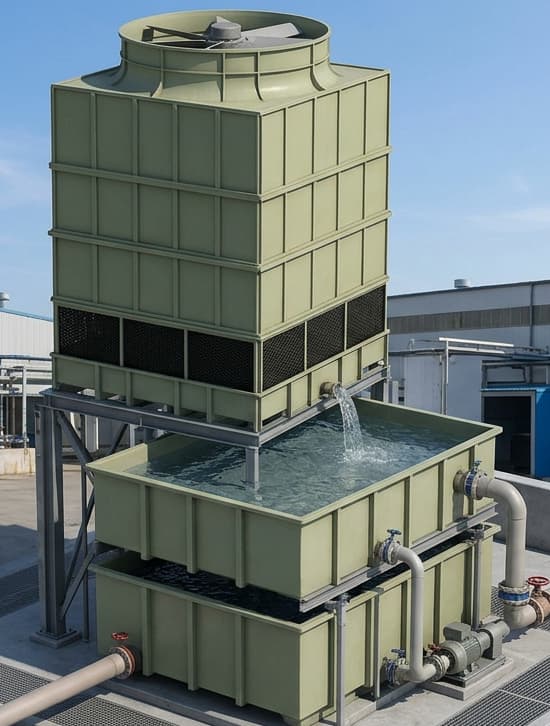
| Process Conditions | |
| Hot Water | 55°C |
| Cold Water | 35°C |
| Wet Bulb Temperature | 29°C |
| Cooling Tower Unit | Range | Rain Density | Wet Surface |
|---|---|---|---|
| 1 | 55–42°C | 18 m³/m² x hr | 28 m² |
| 2 | 42–35°C | 23 m³/m² x hr | 23 m² |
| Total | 55–35°C | N.A. | 51 m² |
| Mixed Water Basin | |
| Temperature | 47.5°C |
| 500 m³ @ 55°C + 300 m³ @ 35°C = 800 m³ @ 47.5°C | |
| Cooling Tower Unit | Range | Rain Density | Wet Surface |
|---|---|---|---|
| 1 unit @ 800 m³/hr | 47.5–35°C | 18 m³/m² x hr | 44 m² |
The single unit saves 13% on wet surface. In reality this leads to an effective footprint reduction of 30% in comparison with a cascading cooling tower (2 units) solution.
On Capex (including installation cost) this option is 15-20% lower than the cascade approach.