


Condenser Cleaning Systems — What Actually Works in Practice
Brush vs. Sponge Ball Systems — A Practical Comparison
Not all condenser cleaning systems perform the same in practice.
This comparison highlights the key differences between brushing and sponge ball systems — focusing on cleaning consistency, system behavior, and real-world operation.
Deterministic vs Probabilistic Cleaning in Condenser Systems
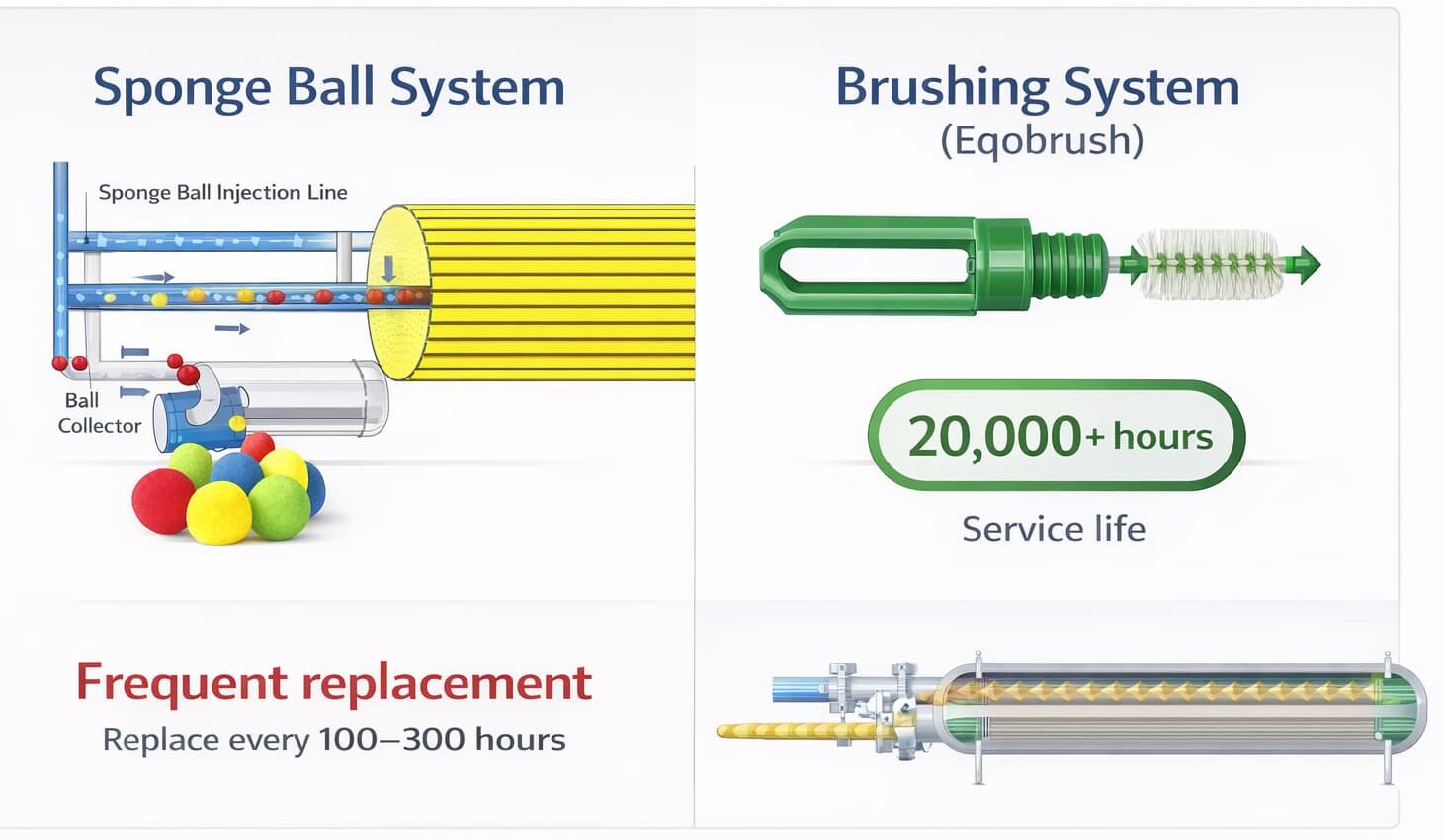
Brush vs Ball Cleaning: A Practical Performance Comparison
Brush System Principles of Operation
- Brushes sit in catch baskets at the end of each tube.
- Place a flow reversal valve between the cooling tower and the condenser.
- Propel the brushes through the tubes at regular intervals by reversing water flow in the condenser for a short period. The brushes remove all sediment and fouling during the cleaning cycles.
Brush System Advantages
- Deterministic Cleaning: Every tube - Every cycle
- Low maintenance - High reliability
- Lowest Total Cost of Ownership (TCO)
Ball System Principles of Operation
- Inject sponge balls into the cold-water pipe from the cooling tower.
- The balls travel through the condenser tubes and remove fouling on the way.
- After the condenser, trap the balls in a strainer and keep them in a ball reservoir until the next cycle.
Ball System Advantages
- Cleaning Device Material Flexibility
This flexibility can be beneficial in systems with varying operating conditions or sensitive surfaces.
- No size limitations
This makes them suitable for even very large installations, where the Flow Reversal Valves of brush systems are limited in pipe diameters >900 mm.
- Lower initial investment (CAPEX)
This can make them attractive for projects with strict capital expenditure constraints.
Historical Context:
2 Condenser Cleaning Systems that work.
Germany’s MAN Turbine Manufacturing initiated the development of on-line or continuous condenser cleaning systems for their power plants in the last century. The company asked its two senior engineers (Hermann Heeren and Josef Taprogge) independently to come up with a solution for efficiency loss due to fouling.
Hermann and Josef retreated to their design benches to wrack their brains for the best solution. Inspiration struck both individually, gifting us with two types mechanical on-line cleaning systems: Brush Cleaning by Hermann, Ball cleaning by Joseph.
Both condenser cleaning systems proved workable—though Hermann couldn’t resist asking Joseph whether he’d also recommend sponges as a tool in a dental hygiene strategy?
The Pitfall of Neglected Ball Cleaning Systems:
Don't let the Solution become your Problem!
Failure to maintain the ball-type condenser cleaning system can result in tube fouling, reducing diameter and compromising efficiency. Subsequent replacement ball addition risks misfitting, leading to tube blockages. Once cleaned tubes become a blockage hazard. Regular maintenance is critical to prevent such issues, ensuring optimal system performance and longevity.
In practice, the recurring issue arises when operators opt to cut costs by neglecting the timely replenishment of sponge balls. This oversight leads to operational challenges and compromises system efficiency. Timely ball replenishment is essential to maintain the optimal performance of these condenser cleaning systems and prevent costly disruptions in the operation of your chiller.
Selecting the right Condenser Cleaning System:
Make the right choice — and make sure it is implemented properly.
The selection of a condenser cleaning system is not a detail. It directly impacts performance, operating cost, and long-term reliability.
Once you have made your choice, ensure it is reflected correctly in the design. Do not hesitate to challenge your project consultant if a system is casually specified without clear justification.
Ask the questions that matter: consistency of cleaning, operator dependency, and lifecycle cost. A system that looks acceptable on paper can become a recurring operational issue in practice.
Your long-term performance depends on it.


10-Year Period Total Cost of Ownership Comparison:
THE NUMBERS DON'T LIE
Our analysis shows that for a 2,000-tube chiller, the Total Cost of Ownership (TCO) of a brush ATCS is about US$30,000 lower over 10 years compared to a ball ATCS.
But this is just the headline. The full comparison breaks down:
- Consumables cost over 10 years (balls vs. brushes)
- Maintenance and labor requirements
- Hidden risks that drive unplanned costs
- Strategic recommendations for consultants and facility managers
The Pitfall of Neglected Ball Cleaning Systems:
DOWNLOAD THE FULL 23-PAGE REPORT
Want the complete data-backed comparison to guide your next ATCS decision?
Download our ATCS Cost of Ownership Comparison (10-Year Analysis) now.
Simply enter your email below and get instant access to the full report, including a practical Sponge Ball Procurement Checklist.
And remember — if you already operate a ball-type ATCS, cutting costs on replacement balls is a short-sighted and risky move. Using cheap, low-quality balls can actually worsen fouling, cause tube blockages, and multiply the very problems the system was meant to solve.