


Watco Fundamentals
What Is Cooling? (And why Heat Rejection Is the Heart of Every Cooling System)
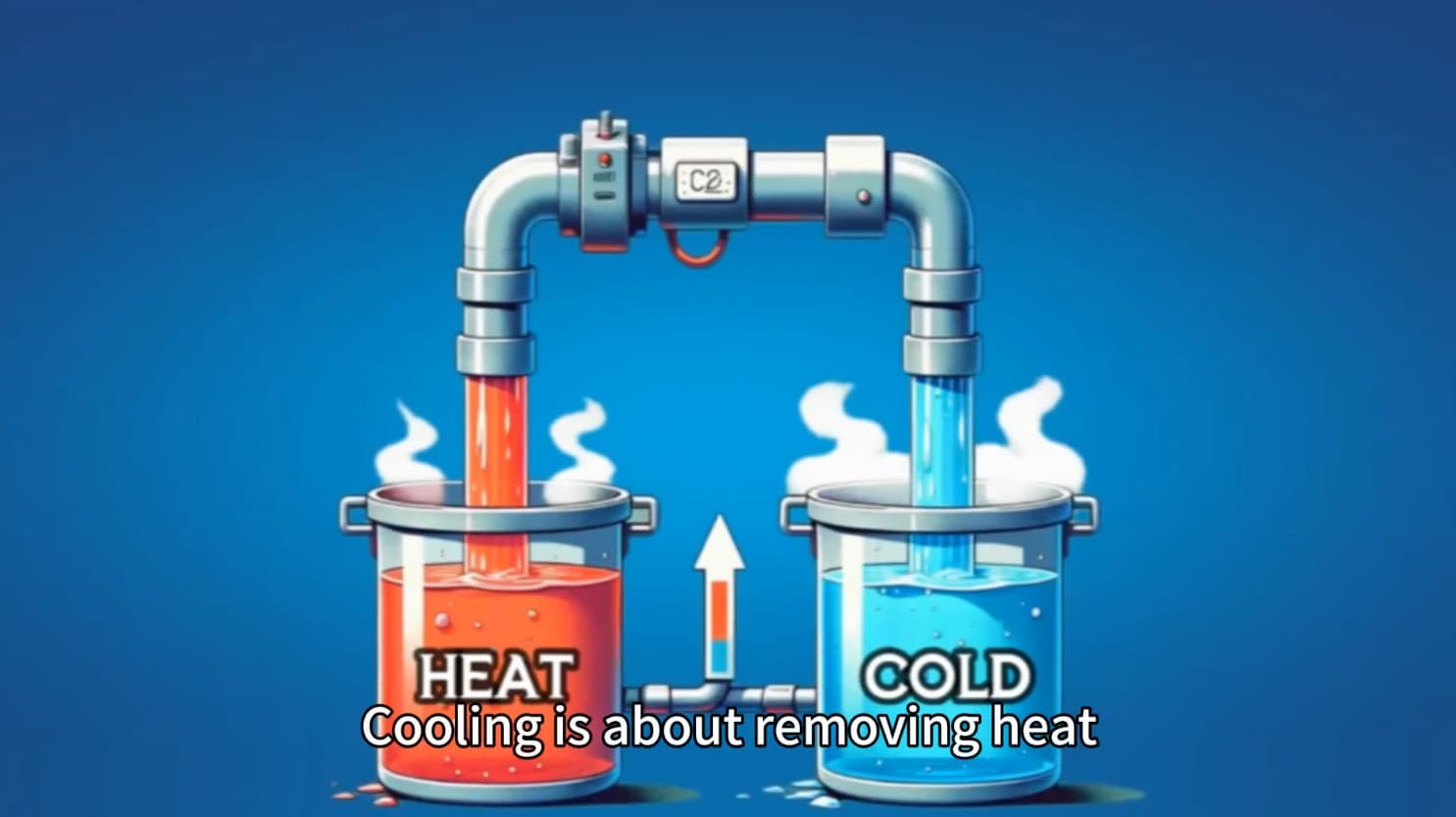
Cooling is simply the removal of heat — if the heat rejection pathway is blocked, there is no cooling.
What is cooling, really?
Ask most people what cooling does and they’ll tell you it makes things cold. It’s an understandable assumption — air conditioning cools a room, a chiller cools process water, a cooling tower cools a building. Cold is what you feel. Cold is what you measure.
But cold is not what cooling produces.
Cooling is the process of removing heat. Not creating cold — removing heat. That distinction sounds like semantics until you realise it changes everything about how you diagnose, design, and maintain a cooling system.
Think of it this way: you create darkness by switching off the lights. Darkness is simply the absence of light — you don’t manufacture it, you remove what was there. Cold works the same way. You don’t create cold. You remove heat, and cold is what remains.
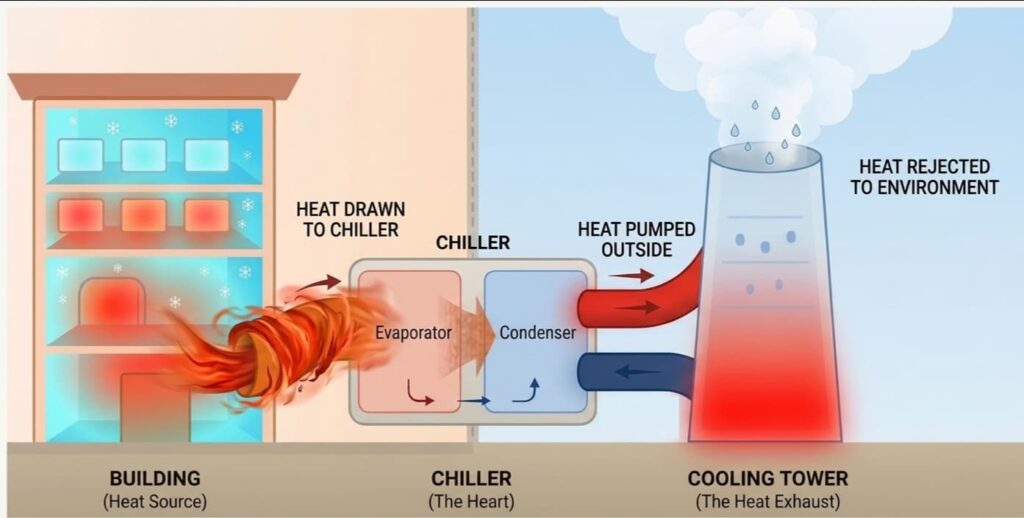
Every chiller, every condenser, every cooling tower in your facility exists for one purpose: to move unwanted heat from one place to another. Heat is collected from your process, transported through the system, and finally discharged to the environment. The moment heat cannot be moved efficiently, performance collapses — regardless of how powerful your equipment is on paper.
The cooling chain: from process to environment
In any industrial or commercial cooling system, heat follows a chain:
Process → Chiller evaporator → Refrigerant circuit → Condenser → Cooling tower → Atmosphere
Each stage hands heat to the next. The chiller absorbs heat from chilled water circulating through your process. The refrigerant carries it to the condenser. The condenser transfers it to condenser water. The cooling tower rejects it to the atmosphere.
If any link in that chain is compromised, the heat has nowhere to go. It backs up. Temperatures rise. The system compensates by working harder — consuming more energy, reducing capacity, shortening equipment life.
The weakest link is almost always at the point of heat rejection, not at the point of cooling production.
Chiller performance is frequently blamed for problems that originate downstream, in the condenser circuits or the cooling tower.

The blocked drain analogy
To understand where performance is lost, it helps to first understand what the chiller actually is.
The chiller sits on the dividing line between two halves of the cooling system. On one side — the evaporator — it absorbs heat from the chilled water circuit serving your process. On the other side — the compressor and condenser — it begins the work of pushing that heat out of the system toward the cooling tower and ultimately the atmosphere. The chiller is not upstream of the problem. It is the heart of the system: the pump that keeps heat moving from one side to the other.
This distinction matters enormously when diagnosing performance loss.
Now imagine a kitchen sink. Water flows in, a pump pushes it through, and it drains out the other side. Everything works. Now imagine the drain becomes partially blocked. The pump doesn’t fail — it keeps running — but it has to work harder to push water through the restriction. Flow slows. Back-pressure builds. The pump runs hotter, consumes more energy, and eventually something gives.
A fouled condenser or underperforming cooling tower does exactly this to your chiller.
Heat enters the system from the process side at a continuous, predictable rate. The chiller’s job is to pump that heat across the system boundary and into the rejection circuit. But if the heat rejection pathway — the condenser tubes, the cooling tower, the heat exchangers — is restricted by fouling, scaling, or biological growth, heat cannot leave fast enough. Condenser water temperatures rise. The temperature differential the chiller needs to work across becomes less favorable. The compressor has to work harder. Energy consumption climbs. Capacity drops.
The drain was blocked. The pump — the chiller — gets the blame.
This is why facility teams often replace or upgrade chillers when the real problem lies entirely on the dissipation side of the system: in condenser tubes that haven’t been cleaned in two seasons, in cooling tower fill clogged with scale, in heat exchangers operating at a fraction of their rated capacity. The chiller is the most visible, most expensive component — so it attracts attention. But a chiller cannot reject more heat than the downstream system allows it to.
What does efficient heat rejection actually require?
For heat to leave the system reliably, three conditions need to be met:
1. Clean heat transfer surfaces
Fouling on the internal surfaces of condenser tubes, heat exchangers, or cooling tower fill creates an insulating layer between the process fluid and the heat rejection medium. Even a thin biofilm — less than a millimetre — can reduce heat transfer efficiency by 20–30%. The fouling doesn’t cause an alarm. It just gradually raises condenser water temperatures and increases compressor lift.
2. Adequate flow and contact time
Heat transfer requires time and contact area. Reduced flow — from pump wear, valve misalignment, or blocked strainers — means the heat transfer medium spends less time at the surface and carries away less heat per pass.
3. A sufficient temperature differential
The system rejects heat because the cooling medium is cooler than the fluid being cooled. If ambient conditions push up the wet-bulb temperature, or if condenser water temperatures have crept up due to fouling, that temperature differential narrows. Heat cannot be rejected as efficiently, and the chiller works harder to compensate.
All three factors interact. Fouling reduces heat transfer, which raises condenser water temperature, which narrows the temperature differential, which increases compressor energy. The effect is cumulative and often goes unnoticed until energy bills arrive.
Why heat rejection is systematically underestimated
Capital investment in cooling tends to concentrate at the production end of the chain: high-efficiency chillers, variable-speed drives, sophisticated building management systems. These are expensive, visible, and easy to justify in a capital expenditure proposal.
The heat rejection end — condenser tubes, cooling towers, plate heat exchangers — is maintenance territory. It’s harder to quantify the cost of gradual fouling. There’s no alarm that says “your condenser tubes are 15% fouled.” The system simply costs more to run, and efficiency drifts downward quarter by quarter.
This is why many facilities operate chillers at significantly higher energy consumption than their design specifications — not because the chillers are ageing, but because the heat rejection side has never been systematically maintained.
The question to ask is not: how good is our chiller?
The question is: how reliably can we reject heat?
The performance question to ask
When you’re evaluating the performance of your cooling system, start at the end of the chain, not the beginning. Check your condenser water supply and return temperatures against design values. Also check your cooling tower’s wet-bulb approach — the difference between the cold water temperature leaving the tower and the ambient wet-bulb temperature. A widening approach is one of the earliest indicators of heat rejection underperformance.
Look at compressor lift — the difference between evaporating and condensing pressure. Track energy consumption relative to cooling load over time.
If those numbers are drifting, the most likely cause is heat rejection performance degrading. And the most likely cause of that is fouling — the blocked drain that nobody noticed because the tap was still running.
Keeping heat transfer surfaces clean is not a maintenance preference. It is a prerequisite for the cooling system to function as designed.
Keep your condenser tubes clean — automatically.
See how EQOBRUSH prevents fouling before it impacts performance. Proven in 40+ countries.
This article is part of the Watco Fundamentals series — a practical knowledge base covering the principles behind efficient cooling system design and maintenance.