



Condenser Tube Cleaning in Power Plants: Why Clean Tubes Define Output
Effective condenser tube cleaning in power plants is essential for maintaining optimal performance to avoid 3–5% output from fouled condensers
Fouled condenser tubes silently reduce power plant output.
As deposits build up, condenser vacuum deteriorates — forcing the plant to burn more fuel to produce the same electricity.
In many cases, this loss goes unnoticed in daily operation, but the financial impact is continuous.
The only way to maintain performance is not periodic cleaning — but keeping tubes clean at all times.
In any water-cooled power plant, the surface condenser is the cold end of the steam cycle — and it is only as efficient as its tubes are clean. Fouling from open-circuit cooling water builds silently: biofouling, silt, scaling. Each layer of deposit raises condenser backpressure, reduces vacuum, and cuts output. The plant burns more fuel to produce less power.
Open-circuit systems — drawing from rivers, lakes, seawater, or cooling towers fed by raw water — carry the highest fouling load. This is precisely where Watco’s automatic tube brushing system, EQOBRUSH, delivers continuous, maintenance-free condenser performance without scheduled shutdowns.
The importance of condenser tube cleaning in power plants cannot be overstated; regular maintenance ensures that efficiency remains high.
Use our ROI calculator to quantify the impact — and the payback period.
Field Evidence:
What Is a Surface Condenser and Why Does It Matter?
Understanding the role of condenser tube cleaning in power plants is crucial for any operational strategy.
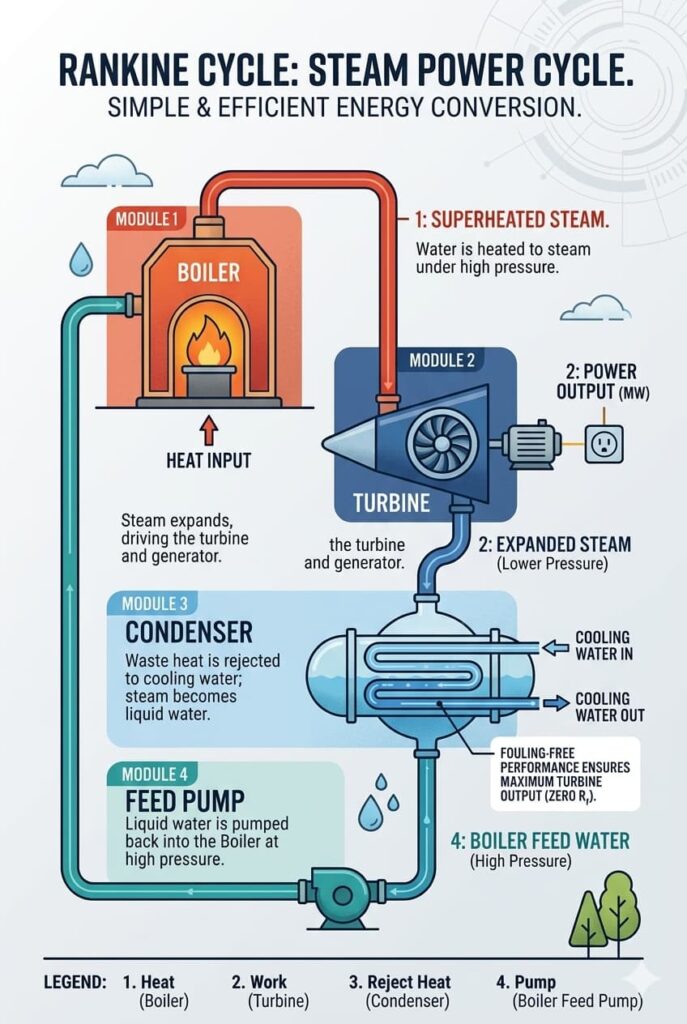
A surface condenser is a shell-and-tube heat exchanger positioned at the exhaust of a steam turbine. Its function is to condense the spent steam back into liquid water, which is then recycled to the boiler. Because the condensation happens at temperatures well below 100 °C, the pressure inside the condenser drops far below atmospheric — creating a vacuum that actively pulls steam through the turbine.
This vacuum is the engine of efficiency. The lower the condenser pressure, the greater the pressure drop across the turbine, and the more mechanical work the steam can deliver. In the Rankine cycle, the condenser represents the heat rejection step — and how well it performs determines how much of the fuel’s energy actually becomes electricity.
The cooling medium flows through the tube side; steam condenses on the shell side. There is no contact between the two fluids. This separation is what makes surface condensers preferable to direct-contact condensers in plants where condensate purity matters — and it is also what makes tube-side fouling a hidden but serious performance risk.
Knowledge of condenser tube cleaning in power plants is key to successful management strategies.
The Hidden Efficiency Killer: Condenser Tube Fouling
Effective management of condenser tube cleaning in power plants leads to higher reliability. Fouling is not a maintenance inconvenience. It is a direct tax on every megawatt your plant produces. And in open-circuit cooling systems, it is effectively unavoidable without active countermeasures.
Implementing effective condenser tube cleaning in power plants will greatly reduce fouling risks.
Open-Circuit Cooling Water — The Highest Fouling Risk
Plants that draw cooling water from rivers, lakes, coastal seawater, or cooling towers operating on raw make-up water are continuously introducing biological material, suspended solids, and dissolved minerals into the condenser. The result is a predictable fouling sequence:
Biofouling
bacterial slime, algae, and biofilm adhere to tube walls, providing a base for further deposition and accelerating corrosion.
Particulate fouling
silt, sand, and fine suspended solids settle in low-velocity zones and accumulate on tube surfaces.
Scaling
calcium carbonate, silica, and other dissolved minerals crystallize as water temperature rises across the condenser, forming hard deposits that are difficult to remove chemically or mechanically once established.
Macrofouling
in seawater applications: mussels, barnacles, and marine organisms at the tube sheet, restricting flow and causing erosion-corrosion.
Each of these fouling types increases the thermal resistance of the tube wall — and their combined effect is cumulative and rapid.


How Fouling Destroys Condenser Vacuum
Regular condenser tube cleaning in power plants ensures that performance and efficiency are maximized.
The relationship between tube cleanliness and plant output is direct and quantifiable. As fouling builds, heat transfer across the tube wall declines. The steam side temperature rises to compensate, which raises saturation pressure — and the vacuum that the cycle depends on begins to deteriorate.
An improvement in condenser vacuum of just 0.35 inches Hg (12 mbar) translates to a 3 to 3.5% improvement in thermal efficiency.
Sustained clean tube operation — rather than periodic cleaning cycles — is the only way to hold this gain continuously. Plants that rely on scheduled manual cleaning accept a sawtooth performance curve: clean after shutdown, degrading steadily until the next intervention. Automatic tube cleaning eliminates the sawtooth.
The relationship between condenser tube cleaning in power plants and energy efficiency is well documented.
The Downstream Effect: Boiler Tube Failures and Forced Outages
Data-driven approaches to condenser tube cleaning in power plants yield better results.
Fouled condenser tubes do not just reduce output. When scaling progresses to the point of tube wall thinning or pitting, tubes begin to leak. Cooling water — often containing chlorides, suspended solids, or microbiological contaminants — enters the condensate circuit and travels upstream to the boiler. The resulting contamination of boiler feedwater is one of the most common causes of boiler tube failure: underdeposit corrosion, hydrogen damage, and stress corrosion cracking.
The cost of a forced outage from boiler tube failure dwarfs the cost of any condenser cleaning programme. Prevention starts at the condenser.
Deciding on a strategy for condenser tube cleaning in power plants is vital for any maintenance plan.

The Solution: Automatic Tube Brushing with EQOBRUSH
Automatic systems for condenser tube cleaning in power plants offer significant operational advantages.
EQOBRUSH is an automatic tube cleaning system that keeps condenser tubes permanently clean — not periodically clean. There are no chemicals, no scheduled shutdowns for manual cleaning, and no performance degradation between maintenance intervals. The system operates continuously as an integral part of the cooling water circuit.

New Application in AI Data Center Power Supply:
Understanding the requirements for condenser tube cleaning in power plants can enhance overall productivity.
Modular Power Plants
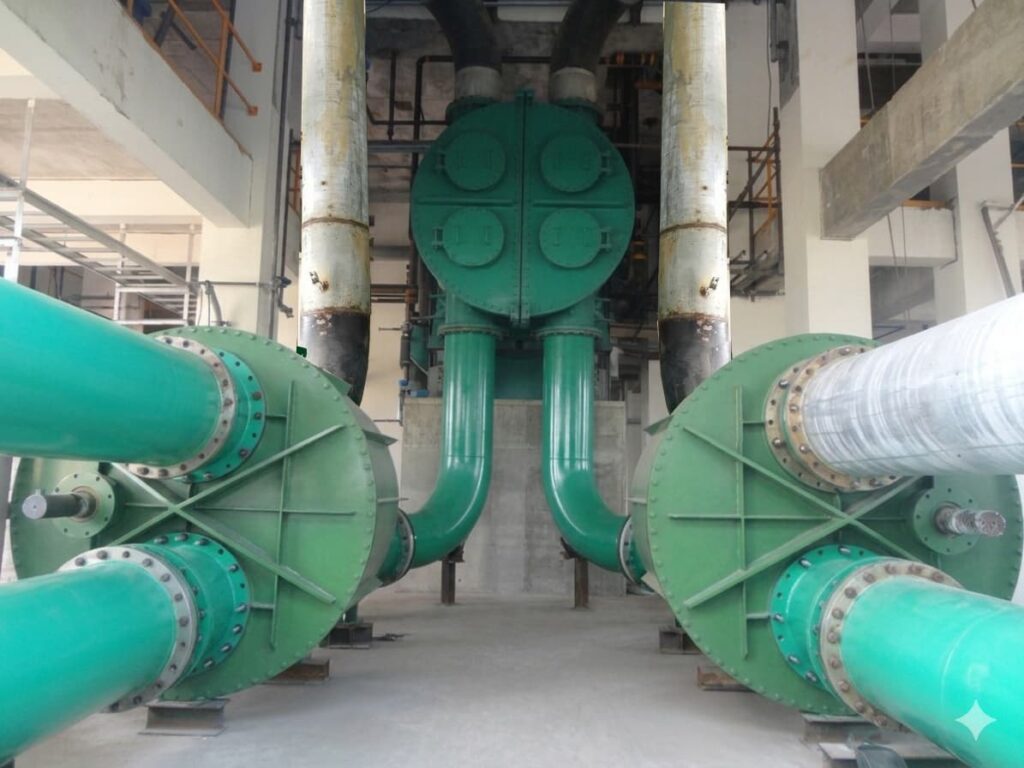
The rapid growth of AI infrastructure has created a structural power supply problem. Hyperscale data centres operated by the largest technology companies require more power than public grid connections can deliver on current timescales. The response across the sector has been to build private, behind-the-meter power generation — modular gas turbine plants installed on-site, bypassing the grid entirely.
Why Compact Condensers Foul Harder
Design Precision vs. Operational Reality
Unlike utility-scale plants with generous fouling margins, modular skid-mounted condensers have zero tolerance. Sized strictly for trailer footprints, these compact units operate at the edge of their thermal design.
In this high-density environment, fouling is not a gradual maintenance issue—it is an immediate operational failure. Even minor efficiency losses force the turbine controller to derate output to prevent overheating. For a 35 MW AI power plant, this translates directly into lost revenue and compromised service levels.
Eqobrush eliminates this bottleneck, guaranteeing design efficiency 24/7.
The future of energy generation is linked to advancements in condenser tube cleaning in power plants.
Where EQOBRUSH Fits: The BoP Skid
The Balance of Plant unit in these modular systems contains the main condenser or heat exchanger, the lube oil coolers, and the cooling water piping — typically in the DN600 to DN800 diameter range. This is precisely the range that EQOBRUSH serves with its standard Flow Reversal Valve systems.
Integration at the factory — before the skid ships — means the OEM can offer a zero-maintenance cooling cycle as a standard specification. For operators running remote or unmanned AI power sites, this is a decisive advantage: no on-site specialist staff required, no scheduled condenser shutdown, no acid cleaning.
EQOBRUSH is compatible with modular power skids up to approximately 40 MW per condenser unit, which aligns directly with the dominant platform in the current AI data centre market. For systems above this output, alternative solutions are available and best discussed during the design phase of new plants.
Choosing the right system for condenser tube cleaning in power plants can enhance operational efficiency.
Is your condenser configuration compatible?
Our engineers can review your cooling system spec — existing plant or new skid design.

Measurable Impact on Plant Performance and Operating Cost
Regular monitoring of condenser tube cleaning in power plants ensures optimal performance levels are maintained.
Importance of Regular Condenser Tube Cleaning in Power Plants
Continuous condenser tube cleaning in power plants is a game-changer for operational efficiency.
The performance case for continuous automatic tube cleaning is well established in power plant thermodynamics. The numbers are not theoretical — they reflect what operators measure when condenser vacuum is maintained at design levels versus allowed to degrade.
- Thermal efficiency: Maintaining design condenser vacuum delivers a 3 to 3.5% improvement in thermal efficiency compared to a fouled baseline — equivalent to recovering several megawatts of output from an existing turbine-generator without any capital investment in the power train.
- Fuel cost reduction: In fossil-fired plants, a 2% improvement in heat rate directly reduces fuel consumption per MWh produced. For plants operating at high utilisation, this alone typically justifies the system cost within 6 to 12 months.
- Boiler tube protection: Eliminating condenser tube leaks removes the primary pathway for cooling water contamination of boiler feedwater — reducing the risk of the forced outages that dominate unplanned maintenance budgets in thermal power plant operations.
- Maintenance cost reduction: Removal of the periodic manual cleaning cycle eliminates the shutdown time, contractor cost, chemical handling, and waste disposal associated with conventional condenser maintenance.
For modular data centre power plants, the economic case is even more direct. In a 35 MW unit, a 5% thermal derating from condenser fouling represents 1.75 MW of lost generation. At the power pricing levels applicable to AI data centre supply contracts, the daily revenue impact of that lost capacity is significant — and the payback period for EQOBRUSH installation is measured in weeks, not months.
Investing in condenser tube cleaning in power plants yields measurable improvements in efficiency.

Frequently Asked Questions
Frequently, condenser tube cleaning in power plants is overlooked, but its impact is significant.
How do the brushes actually move through the tubes?
The brushes are propelled purely by water flow. Each brush sits in a catch basket at one end of the tube. When the Flow Reversal Valve reverses the cooling water direction — which happens automatically every four hours — the water pushes the brush from its basket, through the full length of the tube, and into the catch basket at the opposite end. No mechanical actuators, no external drive. The only requirement is a minimum water velocity of 2 m/s, which is met in any normally operating condenser circuit.
Can EQOBRUSH be installed without taking the condenser offline?
Installation does require a one-time condenser opening and a short planned shutdown. The tubes should be clean and free of hardened deposits before the brushes and catch baskets are fitted — if significant scaling has built up over prior operating periods, a pre-cleaning is recommended. This is a one-time event. Once the system is commissioned, scheduled manual cleaning shutdowns are eliminated entirely.
Is EQOBRUSH suitable for seawater and other aggressive cooling water sources?
Yes. EQOBRUSH handles any cooling water chemistry. At project kickoff we conduct a water quality review and specify the Flow Reversal Valve material accordingly. For seawater applications the valve is available in duplex stainless steel, 316 SS, titanium, or with marine-grade internal coating. The material selection follows the same corrosion policy applied to the rest of the cooling water pipework, so integration with existing plant specifications is straightforward.
What is the maximum condenser size EQOBRUSH can serve?
Standard EQOBRUSH systems cover cooling water pipe diameters up to DN800, corresponding to approximately 40 MW of turbine output per condenser unit. This range covers modular and small-to-medium industrial power plants — including the 35 MW aeroderivative gas turbine class widely used in data centre power applications. For installations above this threshold, the Flow Reversal Valve becomes too large for standard supply. Engineered solutions involving piping rearrangement are available and are best incorporated at the design stage of new plant construction. Contact our team to discuss.
Efficiency in condenser tube cleaning in power plants can directly reduce operational costs.
Does EQOBRUSH work in modular skid-mounted power plants?
Yes, and this is one of the strongest applications for the system. Compact skid-mounted condensers have no excess surface area to absorb fouling — performance degradation is immediate and direct. EQOBRUSH is available in a compact valve configuration suited for the space constraints of trailer-mounted BoP units. Integration at the factory before shipment is the preferred approach, allowing the OEM to deliver a zero-maintenance cooling cycle as standard.
Challenges in condenser tube cleaning in power plants can be overcome with the right technology.
What happens to the fouling material that the brushes remove?
Removed fouling material is carried out of the condenser tubes by the cooling water flow. In cooling tower systems it settles in the tower basin as part of the normal blowdown cycle. In once-through open-circuit systems it is discharged with the outgoing cooling water. There is no accumulation inside the condenser and no separate waste stream to manage.
Utilizing proper methods for condenser tube cleaning in power plants contributes to longer equipment life.