


Watco Fundamentals · Part 2
Heat Removal in Cooling Systems: Why the Back End Defines Performance
A cooling system that struggles to reject heat isn't broken — it's just working harder than it should. And that difference shows up on your energy bill every single month.
The side of your cooling system you rarely think about
Walk through your facility and you’ll see the front end of your cooling system clearly: the process it cools, the chilled water flowing through it, the equipment running steadily. Everything looks fine. And mostly, it is.
What’s harder to see — and far easier to overlook — is the back end. The part of the system responsible for taking all that collected heat and actually getting rid of it.
This is heat rejection. And it is the single biggest determinant of how efficiently your cooling system runs.
Most plant managers focus on chiller capacity, chilled water setpoints, or process temperatures. These matter. But if heat cannot leave the system easily, none of those parameters can save you from steadily climbing energy consumption.
What heat removal in cooling systems actually means
Every cooling system operates on a simple principle: heat is collected from your process and transported to the environment. The chiller doesn’t destroy heat. It moves it.
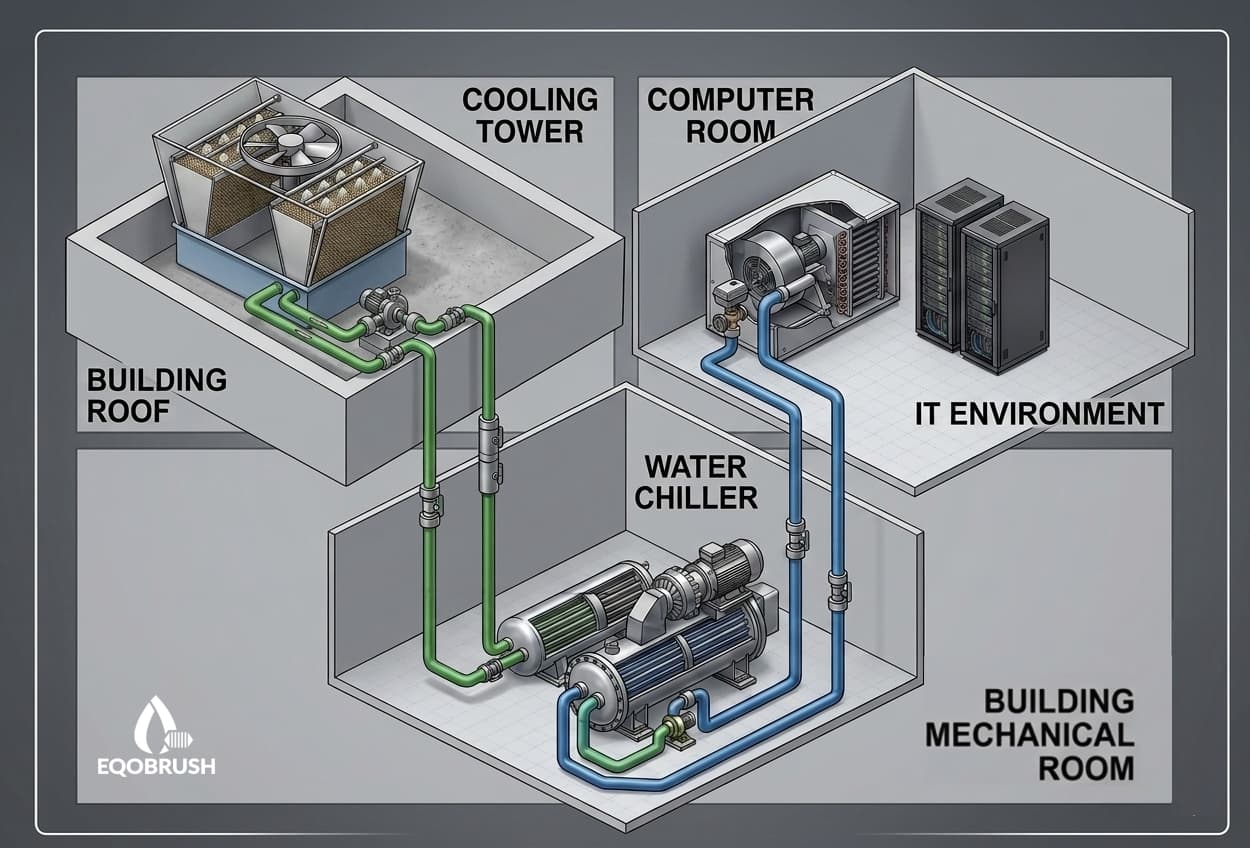
Heat travels a chain: from the process, into chilled water, through the chiller evaporator, into the refrigerant, through the condenser, into condenser water, and finally out through the cooling tower into the atmosphere.
Every link in that chain has to work. But the most critical — and most vulnerable — is the transfer point at the condenser, where heat moves from refrigerant into condenser water. This is where heat rejection either happens efficiently, or doesn’t.
When that transfer is easy, the refrigerant condenses at a low pressure and temperature. The compressor doesn’t have to work hard. The system runs as designed.
When that transfer is obstructed — by fouling, scale, or biofilm on the condenser tube surfaces — the refrigerant needs to reach a higher temperature before it can transfer its heat. The compressor has to work harder to achieve that. Energy consumption rises. Efficiency falls.
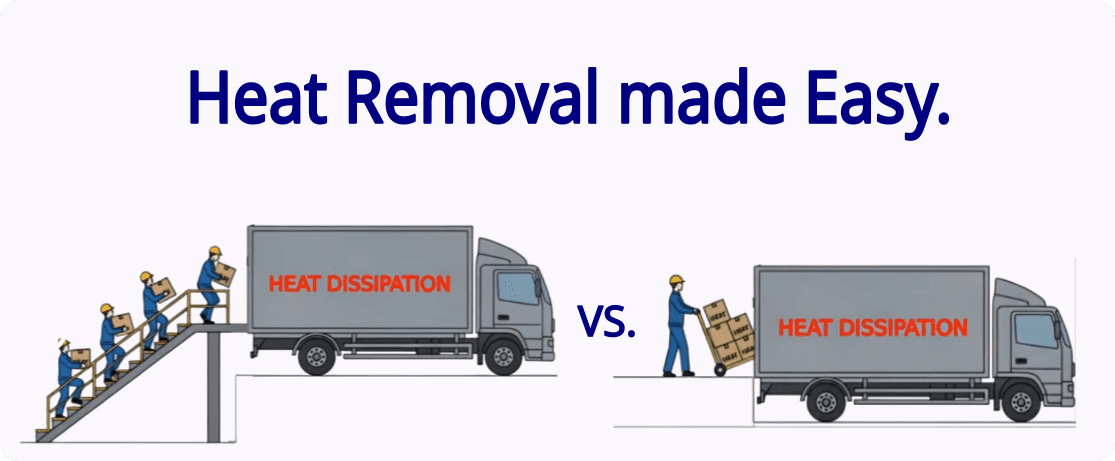
The process still gets cooled. From the front, everything looks normal. But behind the wall, the system is climbing stairs when it could be walking a flat path.
The staircase analogy
Think of heat rejection as moving boxes out of a basement.
When condenser surfaces are clean and heat transfer is unobstructed, it’s one person with a hand truck and a ramp. Three boxes, one trip, minimal effort. The pathway is smooth. The compressor handles a manageable load and the system achieves its designed efficiency.
When fouling builds up on those surfaces, the ramp disappears. Now you need three people hauling boxes up a staircase — one box at a time, one step at a time. The same amount of heat gets moved. The job still gets done. But it takes far more effort than it should.
Both scenarios deliver the result. The fouled system is not alarming. Nothing breaks. No alarm sounds. It’s just quietly consuming more energy than necessary — every hour of every day — to do exactly the same work it was designed to do with ease.

What drives resistance in heat rejection?
Three factors determine how easily heat leaves your cooling system.
1. Condenser tube cleanliness
This is the dominant factor. Condenser tubes carry warm condenser water past the refrigerant. When those tubes are clean, heat transfers readily across the thin metal wall. When they accumulate fouling — calcium carbonate scale, biofilm, silt — that layer acts as insulation. Even a 0.2mm deposit can reduce heat transfer efficiency by 20% or more.
The fouling doesn’t announce itself. Condenser water temperatures drift upward gradually. Compressor current creeps up. Energy consumption rises. By the time it’s noticeable, months of excess energy costs have already been spent.
2. Condenser water flow and temperature
Heat rejection depends on condenser water that is cool enough and flowing fast enough to absorb heat from the refrigerant. If flow rates drop — due to pump degradation, partially closed valves, or blocked strainers — the water spends longer in the condenser and arrives at the cooling tower warmer than designed. The tower has less margin to reject heat to the atmosphere.
3. Cooling tower performance
The tower is where heat finally leaves the system. Its ability to cool condenser water depends on airflow, fill media condition, and critically, the wet-bulb temperature of the ambient air. A tower operating at design on a mild day may struggle on a hot, humid afternoon — reducing the temperature differential available for heat rejection and forcing condenser pressures higher.
Why this is a management issue, not just a maintenance issue
The instinct is to treat heat rejection as a technical concern — something for your maintenance team to handle during the next scheduled shutdown. That framing underestimates what’s at stake.
In a mid-sized facility, a sustained 10–15% reduction in chiller COP due to condenser fouling can mean tens of thousands of dollars in excess electricity costs annually. Multiplied across multiple chillers, over multiple years, the number becomes significant.
More importantly, fouling doesn’t wait for scheduled maintenance. It builds continuously, from the first day condenser water flows through a new installation. The degradation is gradual enough that no single day triggers an alarm — but the cumulative effect on energy costs is substantial.
The question to ask is not: is our cooling system working? The question is: how much energy is it consuming to do that work?
What good heat rejection looks like in practice
A cooling system with excellent heat rejection performance has clean condenser surfaces, consistent condenser water flow, and a cooling tower operating within design parameters. Compressor lift — the pressure difference between evaporating and condensing conditions — stays within its designed range. COP remains optimal relative to its actual running conditions and load.
Maintaining that state requires keeping fouling from accumulating in the first place. Reactive cleaning — descaling during shutdowns, brushing tubes manually on a schedule — addresses fouling after it has already cost you. Preventive approaches that keep surfaces continuously clean eliminate the performance degradation before it begins.
Keep condenser tubes clean — automatically.
See how EQOBRUSH prevents fouling before it impacts performance. Proven in 40+ countries.
This article is part of the Watco Fundamentals series.