

DATA CENTER COOLING
PUE Optimization: The Path to Operational Excellence in Data Centers
In today’s data center market, PUE (Power Usage Effectiveness) is no longer just a metric — it is the “license to operate.” With tightening regulations (such as the 1.3 PUE mandate for new builds in many regions) and exploding energy costs, every fraction of a point gained is a strategic victory.
The cooling chain accounts for the vast majority of non-IT energy consumption — the so-called grey space. This term refers to all supporting infrastructure that does not directly process data: cooling systems, power distribution, lighting, and facility overhead. Grey space is the primary target for PUE optimization. The real challenge is maintaining that efficiency across the entire operational lifecycle — and maximizing every possible minute of natural cooling.
🕐 8 min read | Topics: PUE · Grey Space · Free Cooling · Condenser Fouling · WUE · Predictive Maintenance
Section 01
Maximize the Free Cooling Window (Eqoflush)
The most efficient chiller is the one that is turned off. Free cooling via Plate Heat Exchangers (PHEs) is the single most effective tool for PUE reduction during cooler months — and one of the most underutilized levers in grey space optimization.
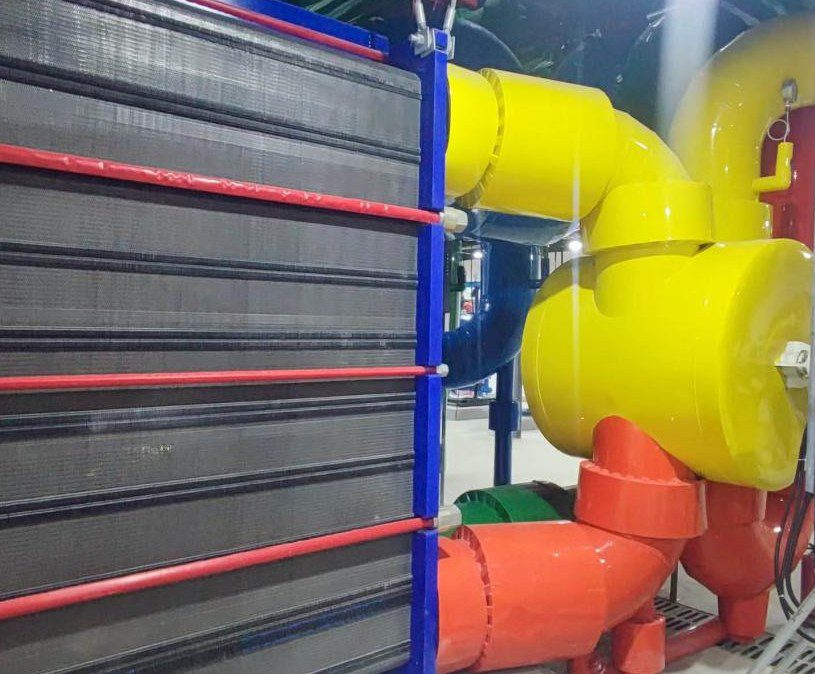
Plate heat exchangers enable free cooling — fouling is the hidden enemy of this efficiency window.
The Challenge: Fouling Shrinks the Free Cooling Window
High-efficiency PHEs are sensitive by design. Even minimal fouling increases the approach temperature — the temperature difference between the cooling water entering the PHE and the process fluid leaving it. As that margin erodes, the mechanical cooling system (the chiller) must activate earlier to maintain IT load temperatures.
In a data center context, this means grey space energy consumption rises before ambient conditions actually require it. The free cooling hours that should be “free” carry an invisible cost.
The Solution: Eqoflush for Continuous PHE Cleaning
By deploying Eqoflush for automatic backflushing, heat transfer surfaces remain pristine throughout the year. Clean plates maintain their design approach temperature, keeping mechanical cooling offline as long as physically possible.
Measured Impact
Eqoflush extends the free cooling window by 600 to 1,400 hours per year, delivering a direct PUE improvement of 0.01 to 0.03 — without touching a single piece of IT equipment.
Section 02
Protect Chiller Efficiency During Peak Summer (Eqobrush)
When ambient temperatures rise and chillers must operate, the condenser becomes the weakest link in the grey space energy chain. This is precisely when grid stress is highest — and when inefficiency is most expensive.
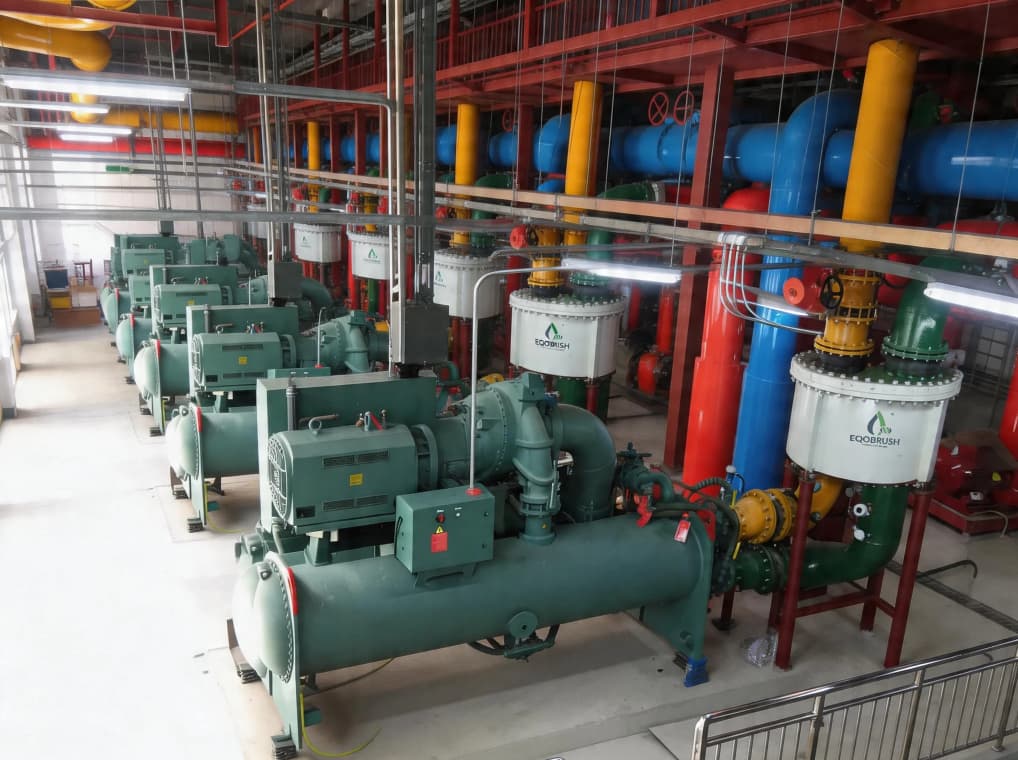
Condenser tube fouling causes compressor overload — Eqobrush prevents this 24/7.
The Challenge: Condenser Fouling and the Compressor Penalty
Cooling tower water carries minerals, biological matter, and suspended solids that gradually deposit inside condenser tubes. The result is a “creeping” rise in condensing pressure. The compressor must work harder to provide the same cooling output.
The physics are unforgiving: every 1°C increase in condensing temperature caused by fouling results in approximately 3% higher electricity consumption. For a 10 MW IT load, this compounds into substantial financial waste over a cooling season.
+3%
electricity increase per 1°C rise in condensing temperature
0.25mm
of fouling is enough to measurably degrade chiller performance
The Solution: Eqobrush for 24/7 Tube Cleanliness
Eqobrush guarantees that chiller condenser tubes remain clean during continuous operation. This locks in the chiller’s design COP (Coefficient of Performance) exactly when cooling demand — and the cost of grey space energy — is at its peak.
Section 03
Address the Water–Energy Nexus (WUE)
PUE is not the only metric under scrutiny. Data centers are increasingly measured on WUE (Water Usage Effectiveness) as well. Regulators, hyperscalers, and sustainability frameworks are all moving in the same direction: less water, less energy, more accountability.
By keeping condenser and PHE systems continuously clean with Eqobrush and Eqoflush, operators can safely run higher cycles of concentration in the cooling tower. This reduces the frequency of blowdown — the controlled discharge of concentrated cooling water — which directly lowers water consumption.
The result: a single operational improvement simultaneously moves the needle on both PUE and WUE. Grey space becomes leaner across two dimensions at once.
Download: PUE Case Study
Documented PUE improvement data from a live data center installation across seasonal cooling conditions (summer/winter).
Section 04
Eliminate Performance Drift with Predictive Maintenance (Eqocheck / SEI)
One of the most persistent blind spots in data center cooling management is performance drift: the gradual, largely invisible decline in chiller efficiency between scheduled maintenance events. Chillers are typically serviced based on calendar intervals, not actual operating condition. By the time maintenance occurs, significant grey space overhead may already have accumulated.
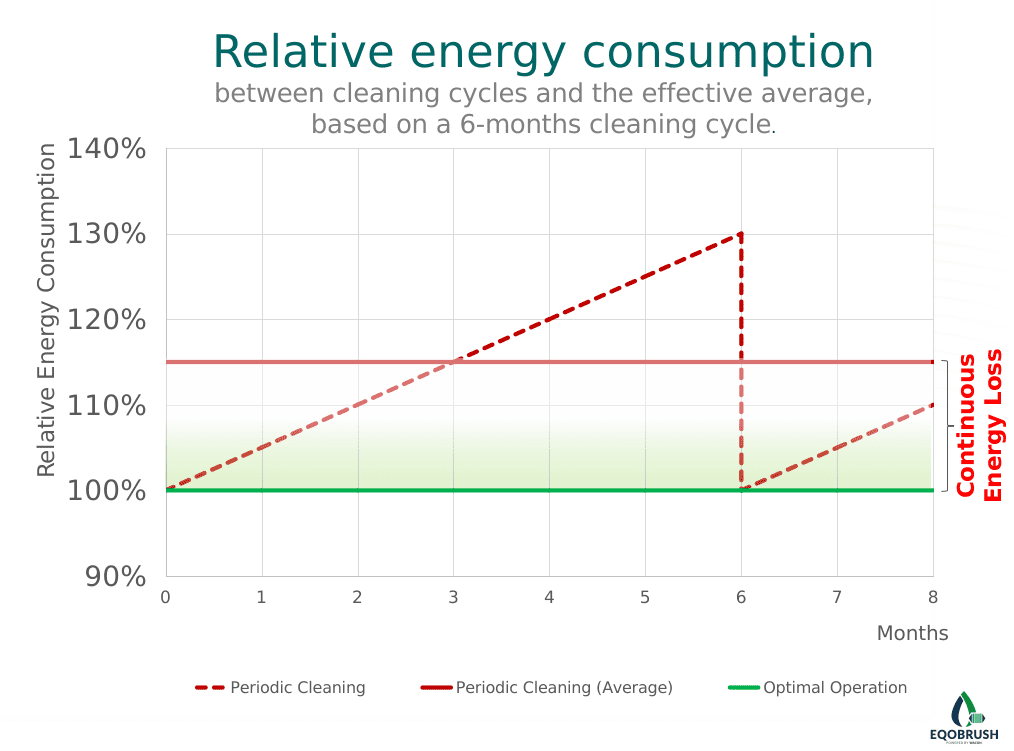
Design Energy Efficiency vs. actual Efficiency over time: the gap between the two lines is your hidden PUE cost.
Benchmarking with the Specific Efficiency Index (SEI)
Eqocheck provides a data-driven alternative. By comparing the achieved COP against the theoretical Carnot COP for any given set of operating conditions, it calculates the Specific Efficiency Index (SEI) — a clear, brand-agnostic measure of how far a chiller is operating from its thermodynamic potential. This “Efficiency Gap” visualization makes it immediately apparent when maintenance is needed to prevent PUE spikes — before they appear on the operations dashboard.
The Physics Behind the Gap
- Every 1°C increase in condensing temperature → ~3% more compressor electricity
- A 1°C rise in PHE approach temperature can trigger chiller start-up during free cooling, adding hundreds of kW of grey space load
- Fouling-induced hydraulic resistance forces pumps to work harder, inflating the "1" in your 1.x PUE figure
- 0.25 mm of fouling in a condenser tube is sufficient to measurably degrade chiller performance
Section 05
The Future: Behind-the-Grid Power and Grey Space Integration
As data centers explore energy autonomy, on-site power generation — gas engines, fuel cells, or combined heat and power installations — is gaining traction. These “behind-the-grid” configurations reduce exposure to grid instability and energy pricing, but they introduce a critical constraint: waste heat must be managed with high efficiency to maintain total system viability.
In these configurations, the cooling plant becomes even more central to overall energy strategy. Clean heat exchangers are not a maintenance detail — they are a prerequisite for the economic case. Grey space that runs efficiently enables the behind-the-grid model to deliver on its promise.
Eqobrush and Eqoflush extend naturally into this architecture, supporting stable condenser and PHE performance regardless of the primary energy source.
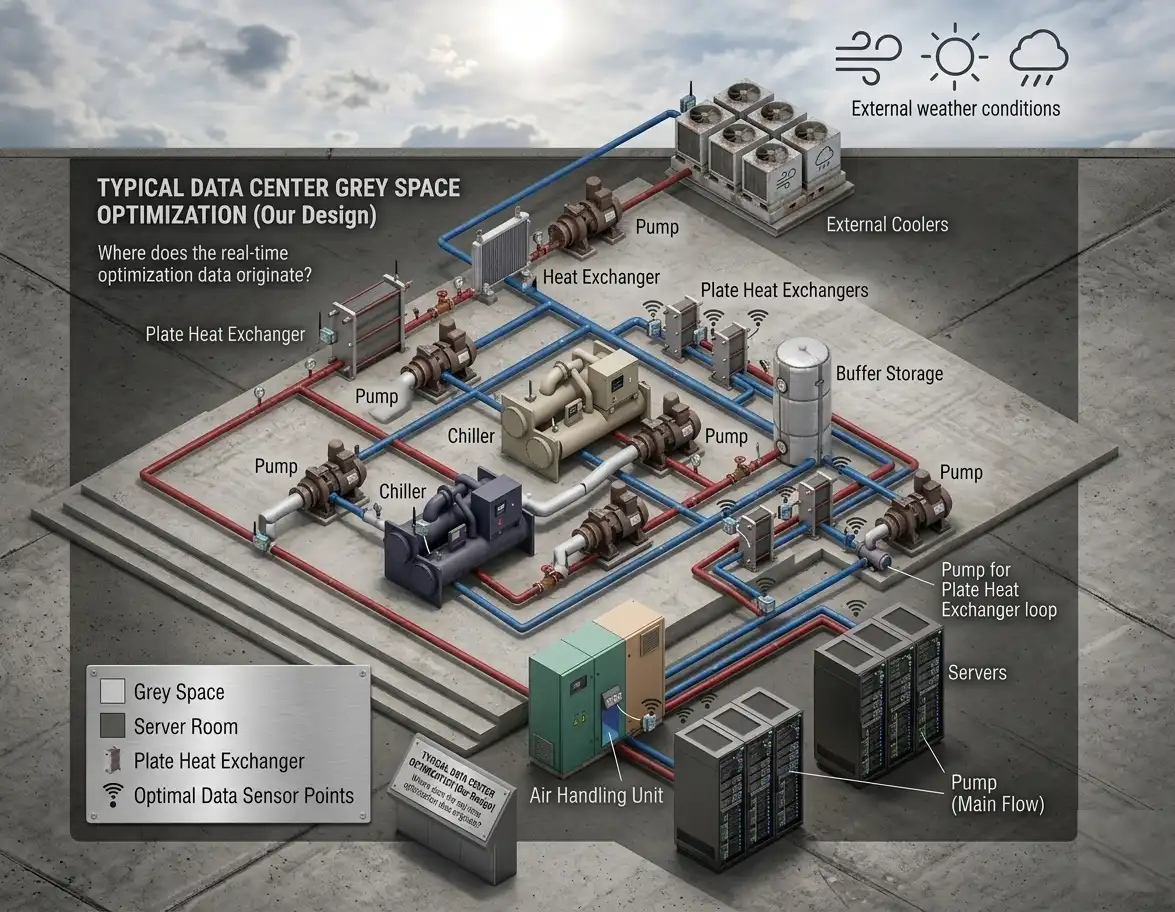
Behind-the-grid configurations require grey space efficiency as a prerequisite — not an afterthought.
Conclusion
A world-class PUE is not achieved with a one-time capital investment. It is achieved by systematically eliminating the variables that allow grey space efficiency to erode over time.
Fouled heat exchangers, degraded condensers, and calendar-based maintenance schedules are not neutral — they are active sources of PUE inflation. By combining automated cleaning (Eqobrush, Eqoflush) with data-driven performance benchmarking (Eqocheck / SEI), operators transform the cooling plant from a cost center into a managed strategic asset.
“The facilities that will lead on PUE in the next decade are not those with the best equipment on day one. They are those that keep it performing at design spec every day after.”
Quantify Your PUE Opportunity
If your current PUE is 1.45 and your IT load is 10 MW, a reduction to 1.42 represents a saving of [X] GWh per year — and a material reduction in operational cost and carbon footprint.